
CupCompass: Visual Identity for Social Media
July 20, 2025
2025 Showreel
January 5, 2026Across a six-month casual design appointment with Monash Education Academy (MEA), I delivered a targeted refresh of the unit’s staff-facing visual identity.
The work involved updating MEA’s dedicated “M” logo with new material treatments that complied with Monash’s brand specifications, redesigning the website banner system, and producing consistent email communication templates used across staff development programs.
The aim was to create a clearer, more coherent identity that reinforced MEA’s positioning as the backstage support for educators.
I established a controlled lighting and gradient framework, refined texture logic, and standardised layout structures so the identity could scale reliably across internal platforms.
These assets form part of MEA’s current communication toolkit and support its ongoing brand governance.
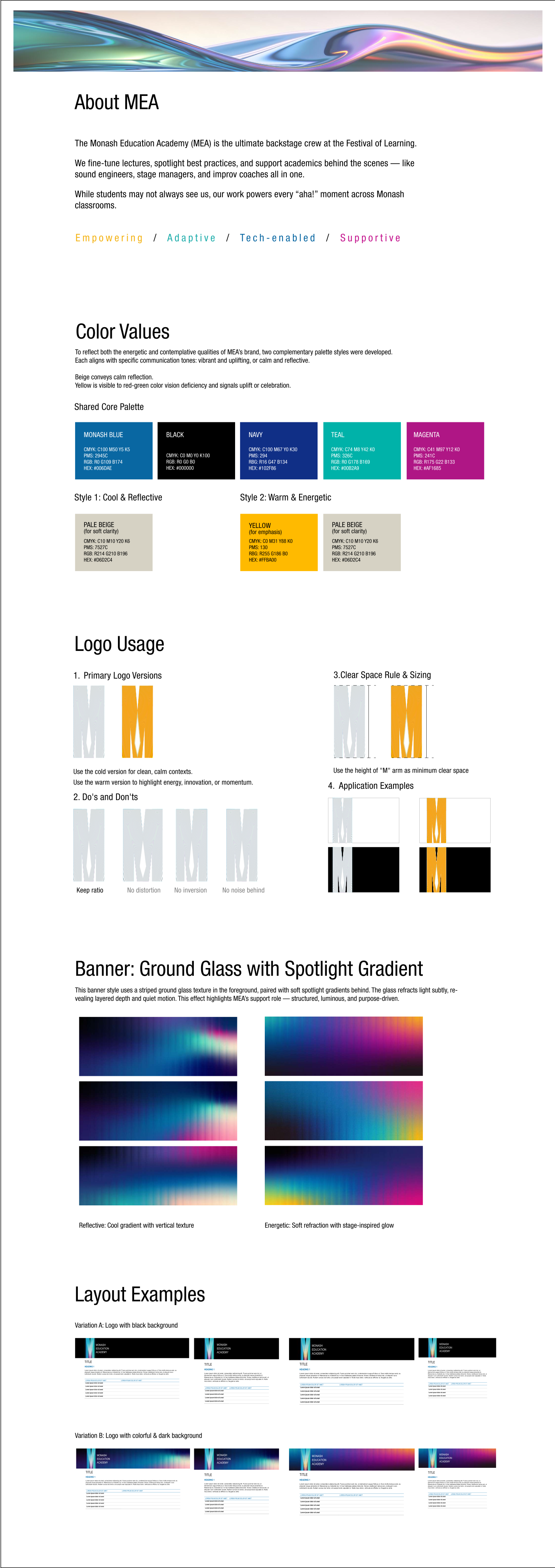
More than support — it’s a spotlight that makes great teaching visible.
Rooted in creativity and collaboration, MEA helps educators discover, share, and amplify learner-centred practice. The refreshed identity translates MEA’s role into a clearer, more contemporary visual language that strengthens recognition and elevates how the team communicates with staff.
By unifying lighting, material cues, and controlled gradients, the system creates a distinct yet adaptable presence across banners, emails, and internal platforms.
Accessibility shaped core decisions. Contrast, typographic scale, and component behaviour were refined to ensure reliable performance for diverse users and varied visual environments.
The identity shines a light on excellence while supporting every educator from behind the scenes—reflecting MEA’s role and the design principles that guided this direction.
2. Creative Development
Reframing a Legacy Mark
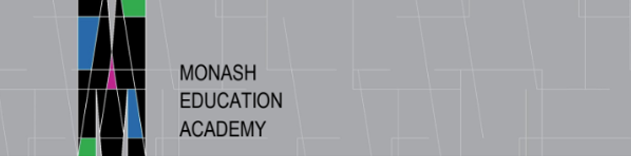
The existing “M” mark carried a heritage look—rigid geometry, muted tones, and a visual language closer to a museum or archival institution. MEA sought a refreshed identity that retained recognisable elements while modernising clarity, material logic, and digital performance. The redesign needed to preserve core colour relationships, introduce a more intentional lighting and texture system, and ensure stronger legibility across staff-facing platforms.
Establishing the Aesthetic Direction
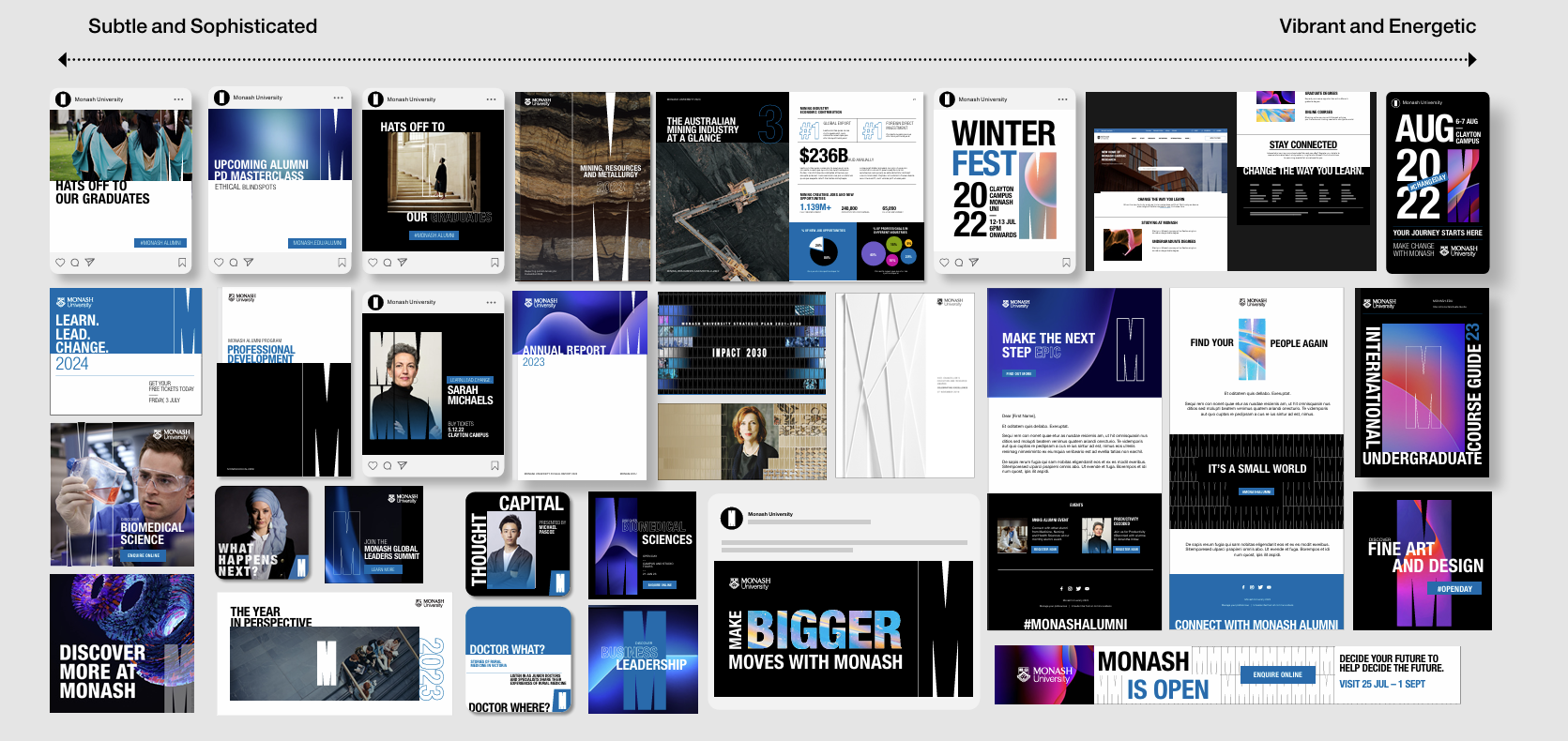
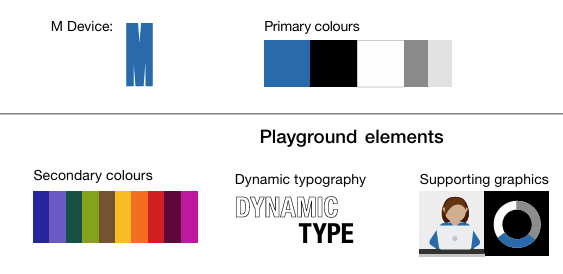
By analysing Monash’s official communications across a spectrum from subtle & sophisticated to vibrant & energetic, clear patterns emerged: restrained colour use, geometric structure, and minimal gradient expression form the core of the university’s visual language. Placing MEA on this axis revealed that its identity should sit centre-left—calm, supportive, and structured—while allowing room for gentle warmth and light-driven accents that differentiate its role without breaking alignment with the master brand.
Defining a Colour System
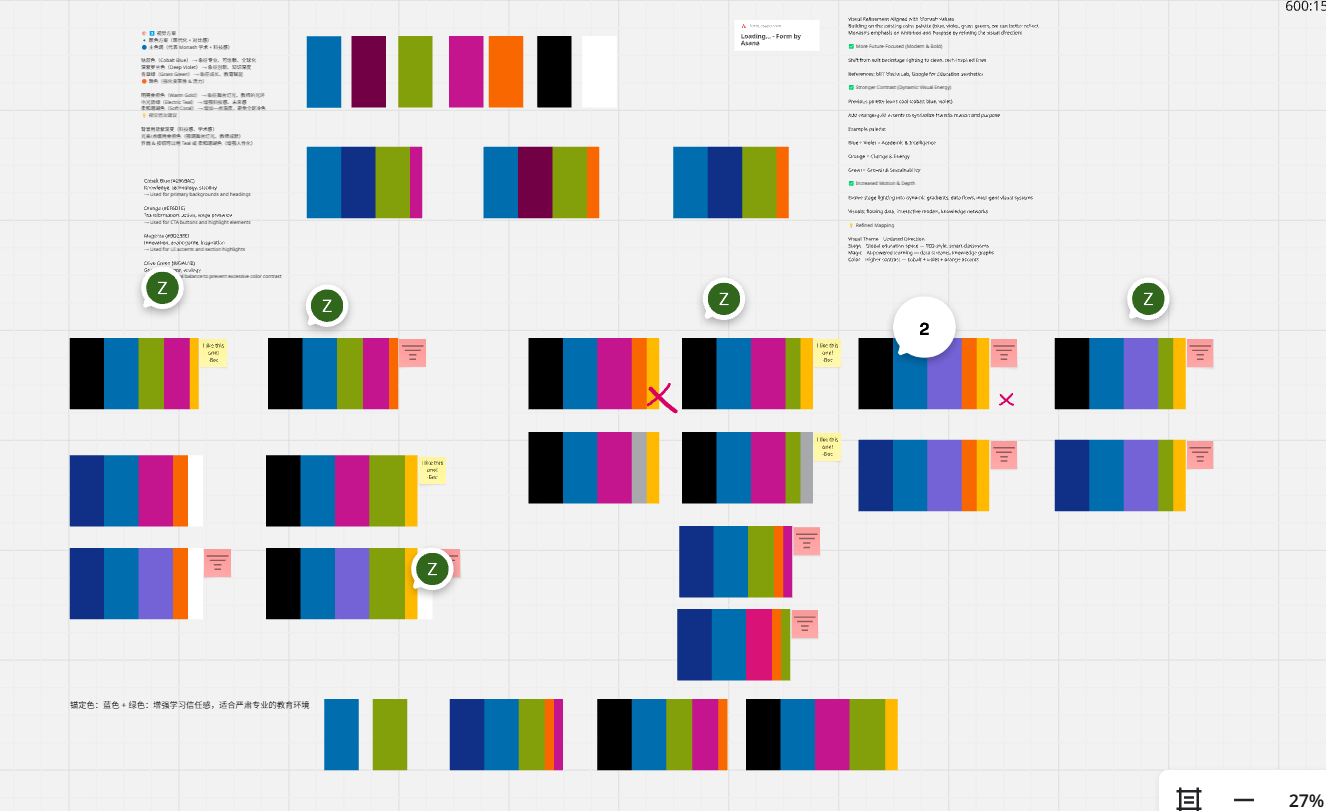
Through comparative palette mapping, a clear direction emerged. The core academic hues of cobalt blue, deep violet, and grass green were retained, while carefully calibrated accent colours were introduced to modernise the identity. Warm gold and electric teal brought a sense of stage-light focus and technological clarity, while soft coral offered a restrained counterbalance to prevent the system from becoming overly cold. These combinations were iterated to establish a palette that feels contemporary, distinctive, and closely aligned with MEA’s position within the Monash ecosystem.
Mapping Visual Territories
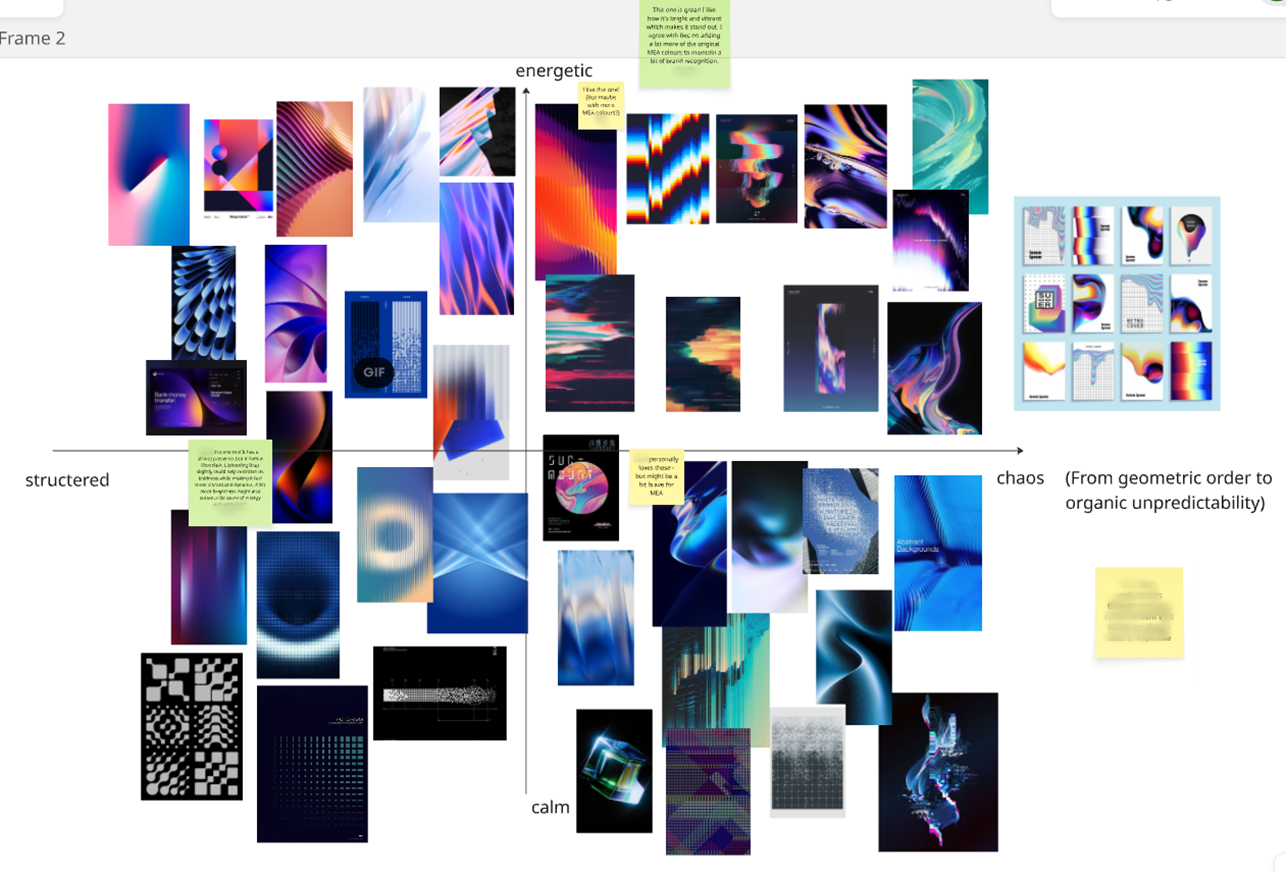
The quadrant mapping revealed three consistently favoured territories: structured calm with light energy, an energetic yet controlled fluid style, and a soft organic aesthetic. During review of early palette tests, several colour combinations were found to collapse into similar tonal values under colourblind simulation, reinforcing the need for palettes with clearer contrast and stronger value separation. Guided by these insights, I developed prompt-based explorations in Midjourney to generate abstract textures such as noise patterns, oil-film surfaces, frosted glass effects and light silhouettes, then added these studies to Miro for further evaluation and alignment.
Exploring Generative References
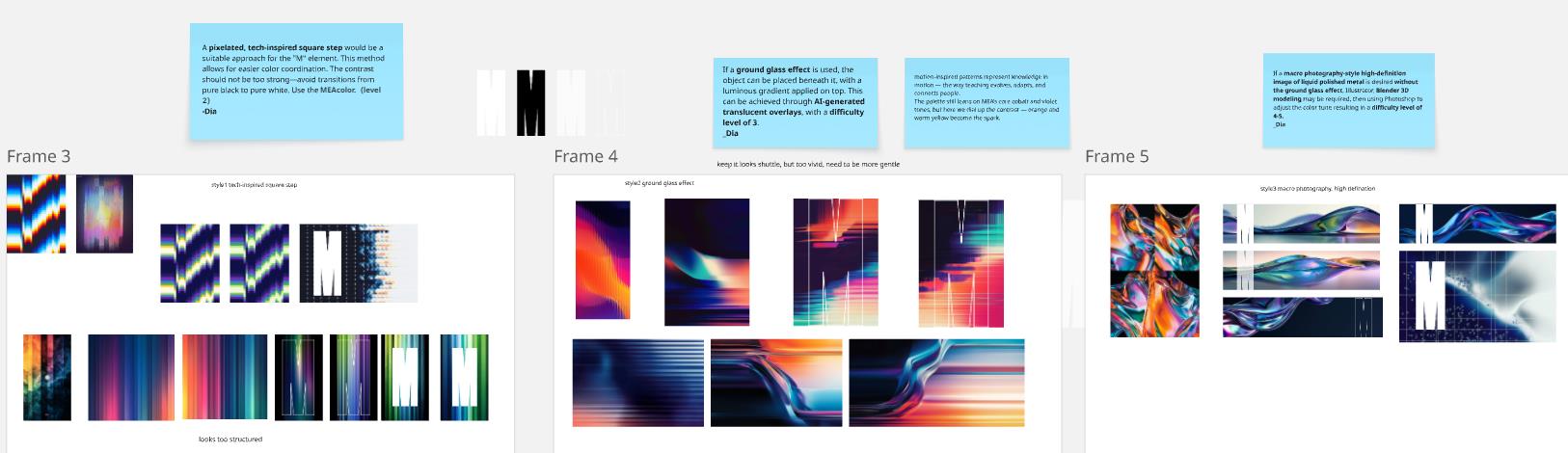
Through broad generative exploration, multiple texture families were tested across lighting, colour and material behaviour. The goal was to identify a style that feels modern, structured and appropriately understated for MEA’s support-role identity. Excessively vivid prism effects were dialed back to avoid visual dominance, and three texture directions were evaluated in depth.
The frosted glass variation emerged as the most aligned, offering soft warmth and clear technological character. Additional iterations included six refined versions of the “M” mark and verification of pull-up banner specifications. The next step is to integrate this selected direction with Monash’s official palette to create a cohesive system.
Building Early Banner Experiments
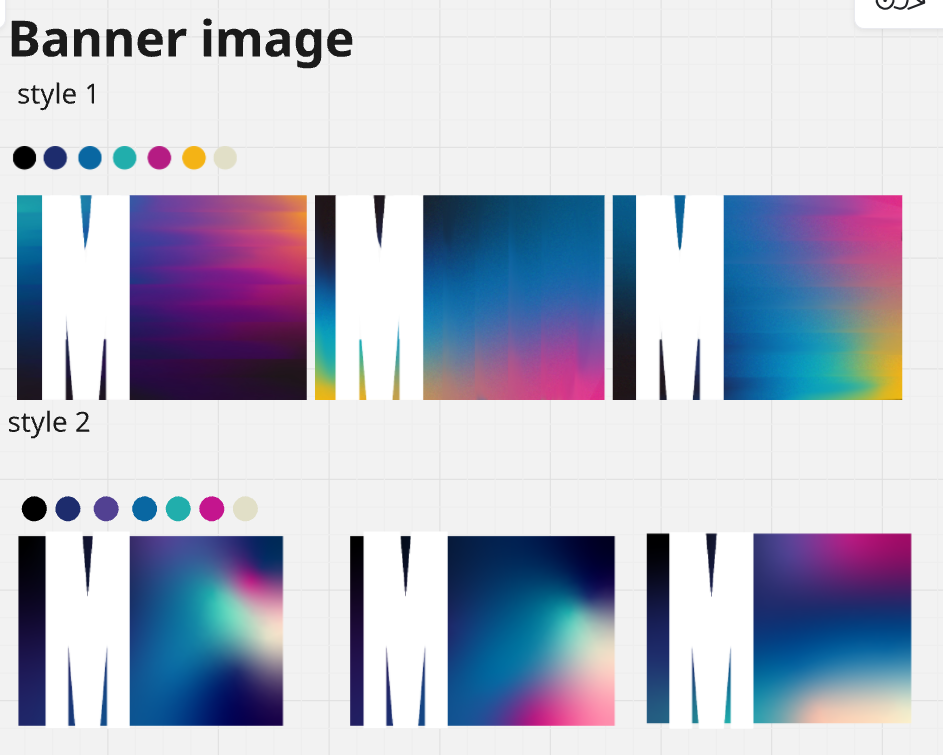
The homepage banner was rebuilt as a vector-based layout to provide a flexible foundation for further refinement. Initial tests explored how a frosted-glass surface might add depth, though applying the effect directly to typography reduced legibility and was limited to background use. Two colour directions were developed in parallel: one with higher contrast for a more expressive tone, and another using blue-violet and cyan for a calmer, more formal presence. These early compositions highlighted the need for material cues—abstract gradients required added texture to communicate intention clearly. A low-resolution prototype of the frosted-glass treatment will be created next to support alignment on the emerging visual direction.
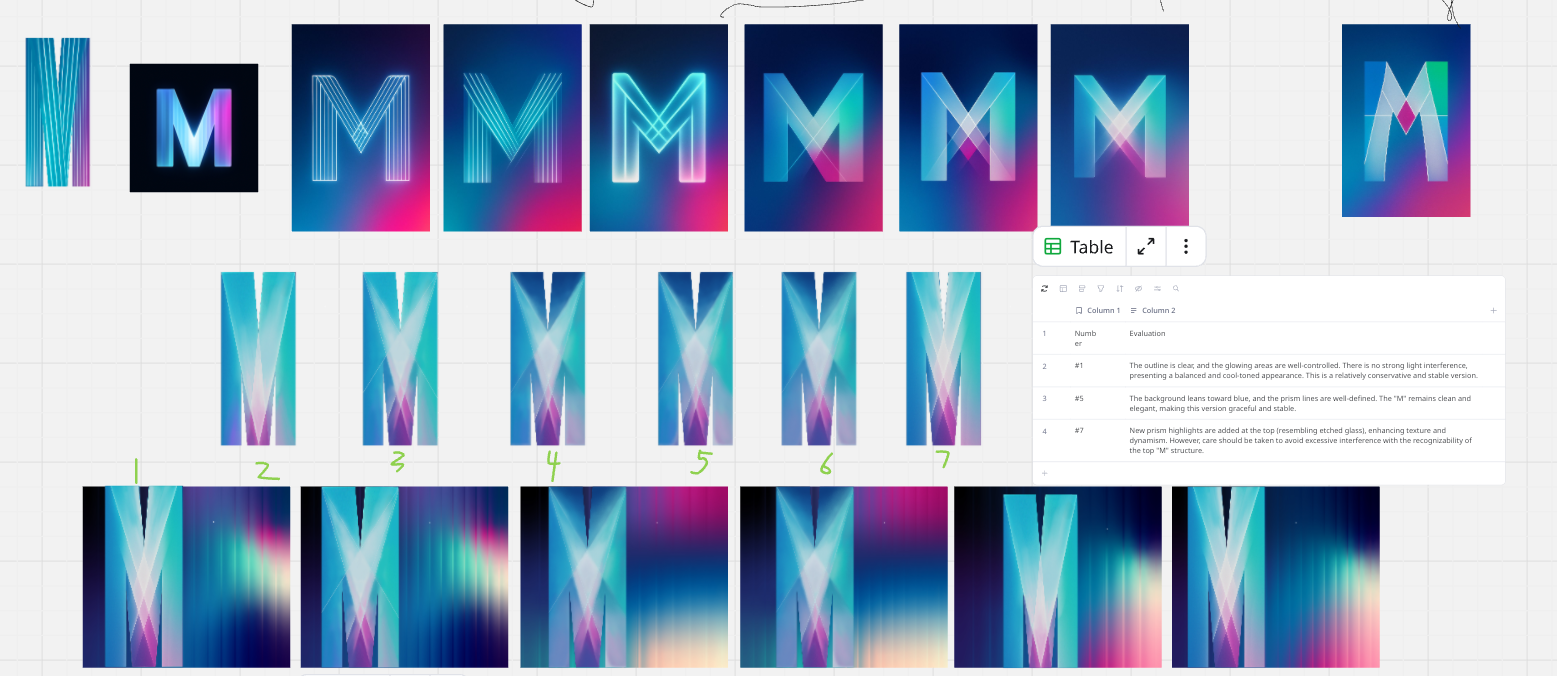
Multiple “M” logo studies were tested across contrast, gradient behaviour and edge clarity. Strong positive–negative contrast proved essential for preserving the silhouette, while overly bright internal highlights reduced legibility. Controlled light layering around the edges created a clearer crystalline depth. Two colour directions were retained as part of a multi-tonal identity approach, offering flexibility for formal and expressive communication contexts. This phase shifted the work from visual iteration to strategic calibration of how the logo behaves across different applications.
Colour Accessibility Testing
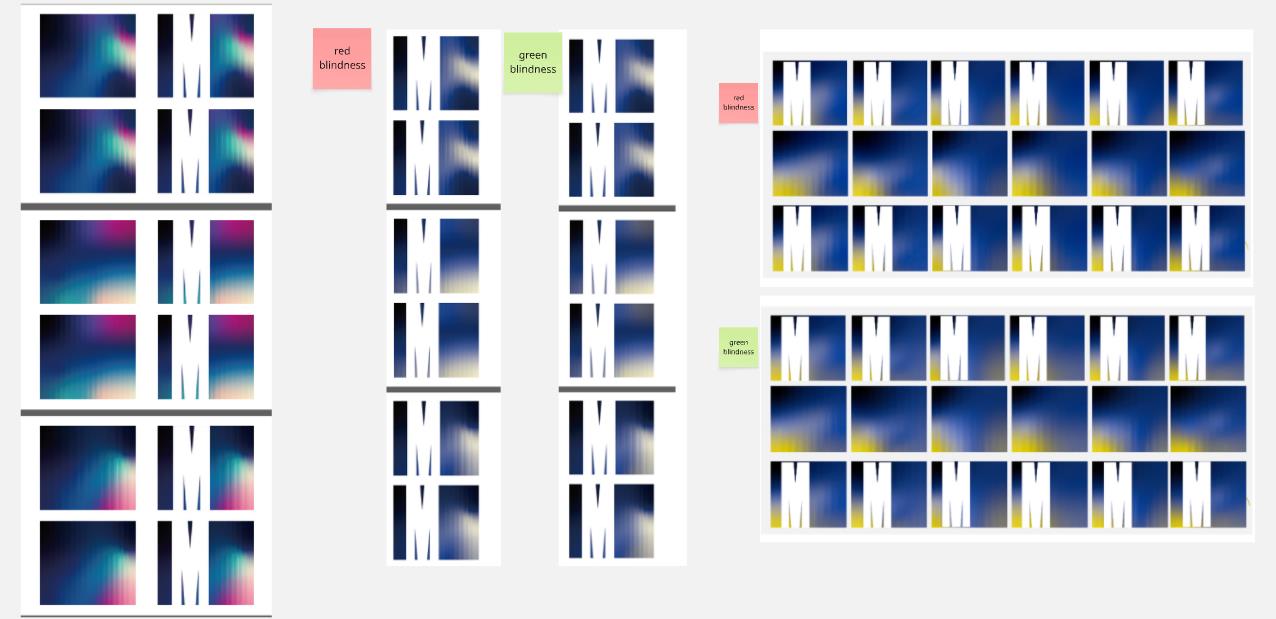
Simulated colour-blind tests were applied to all palette options, revealing that several combinations lost contrast and became indistinguishable. Low-visibility pairs were removed, and two palettes were retained for their strong tonal separation: a warm yellow set that stays highly legible in red-green colour-blind modes, and an ivory set that offers a neutral, calm presence. The outcome strengthens both usability and inclusivity within the identity system.
A Multi-Tonal Identity System
Looking back at the process, it became clear that a visual system is never defined through a top-down decision. It emerges through negotiation — through the meeting of different expectations, vocabularies, and institutional needs. Within an educational context, this negotiation carries even greater weight. Visual identity shapes how educators see themselves, how trust is communicated, and how organisational culture becomes legible to the outside world.
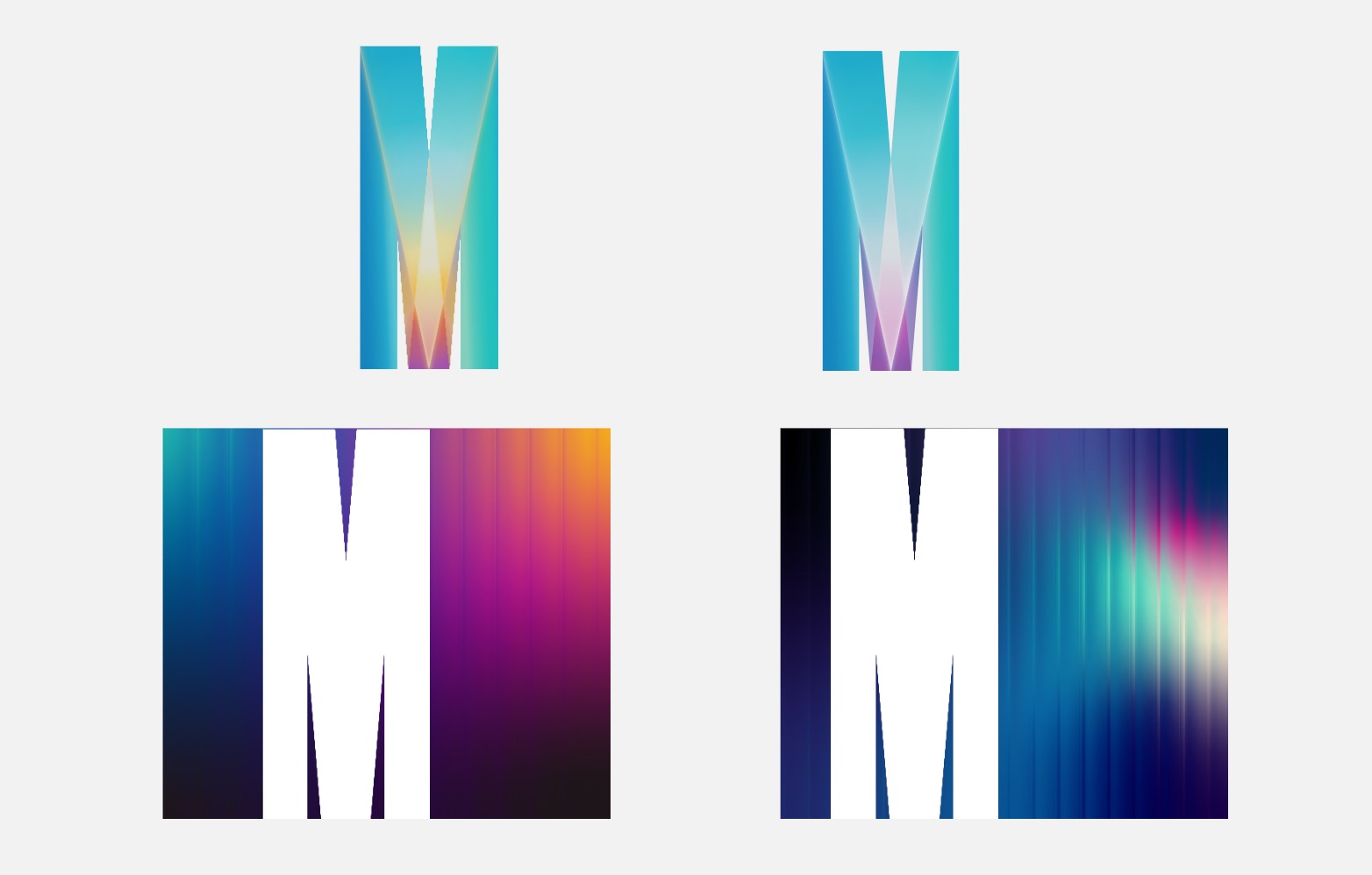
In this sense, the designer is not a final “polisher,” but a mediator who helps translate values, reconcile perspectives, and build a shared visual language. The two final colour directions reflect exactly that: a response shaped not by a single viewpoint, but by a richer, more inclusive conversation.

Expanding Creative Range Through Generative Exploration
To support MEA’s identity evolution, I incorporated generative design workflows to broaden early-stage visual exploration with both speed and intention. These tools allowed the controlled testing of material expression, lighting behaviour, and atmospheric tone, producing a wide set of strategic options rather than ad-hoc aesthetics.
The outcomes were synthesised through a structured evaluation process in Miro, enabling clear stakeholder alignment and more confident decision-making. This approach demonstrates how technology-enabled exploration can strengthen brand development.
I lead identity refreshes end-to-end (logomark, accessibility testing, developer handoff) and am open to permanent or contract roles in brand/product design.